Author: terakoyamaster

  • Making Your Practice Records Even More Meaningful

    Making Your Practice Records Even More Meaningful

    We have added several new features to the Practice Record section of Terakoya Cloud to help you elevate your daily sessions.

    Practice Hints

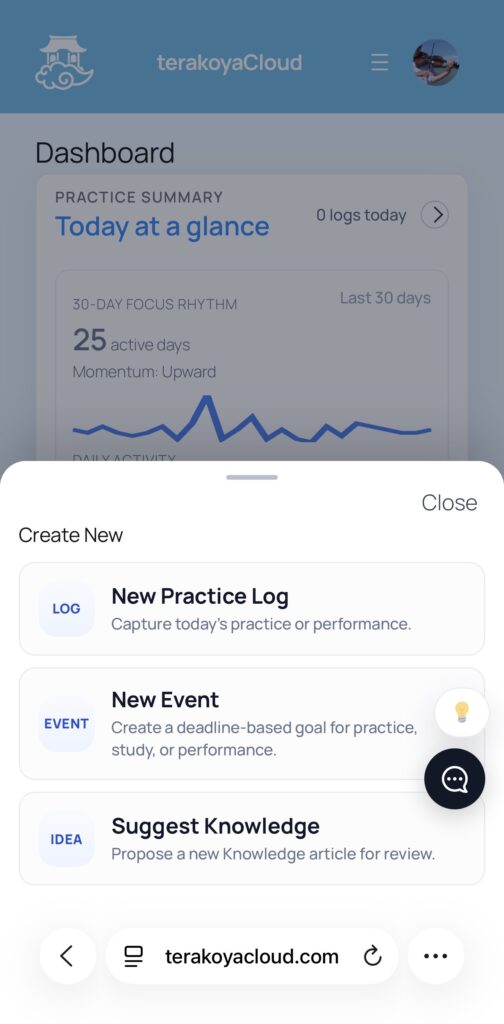
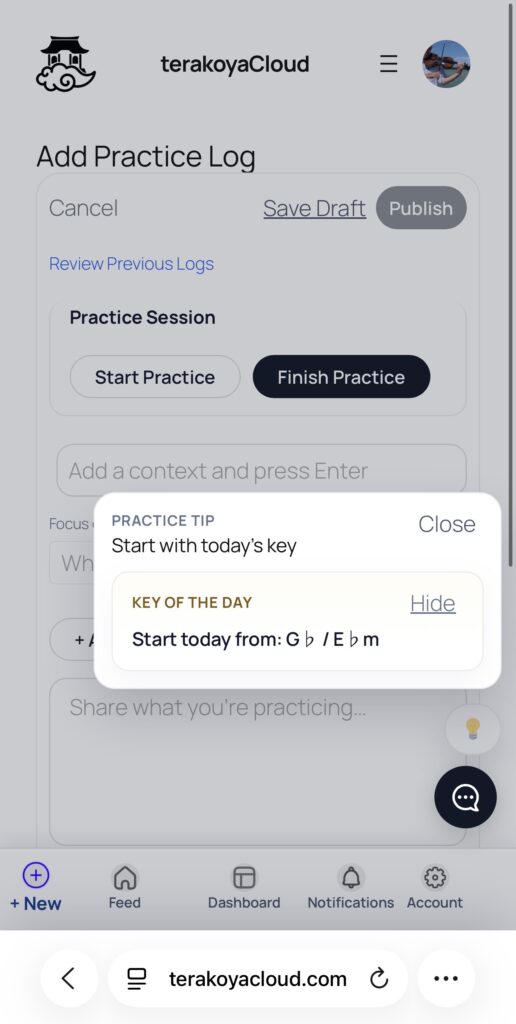
    First, you’ll notice a new lightbulb icon (💡) on your practice record screen and dashboard. Clicking this will display helpful tips for your practice. Currently, it features “Today’s Key.”

    Instead of always starting with C Major, changing your key daily adds depth and variety to your scale practice. We plan to roll out more useful tools here in the future. If you have any great ideas, we’d love to hear them! Please share your thoughts via the comment icon (💬) located just below.

    Screenshot

    Time Tracking

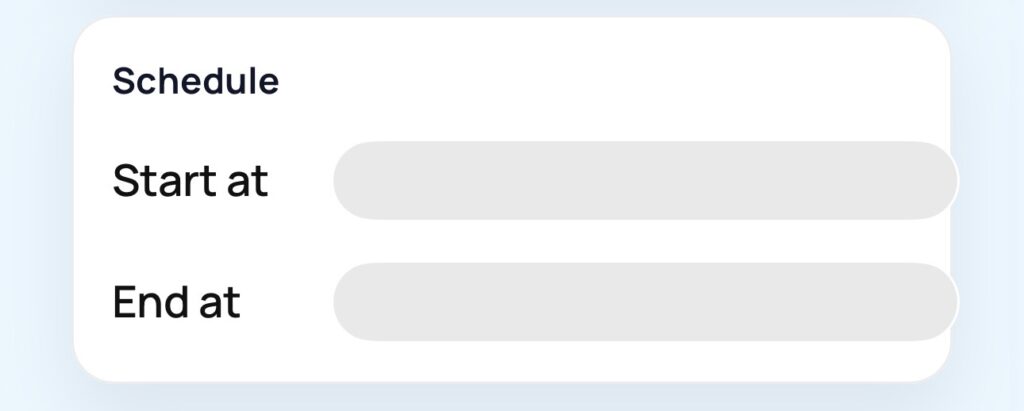
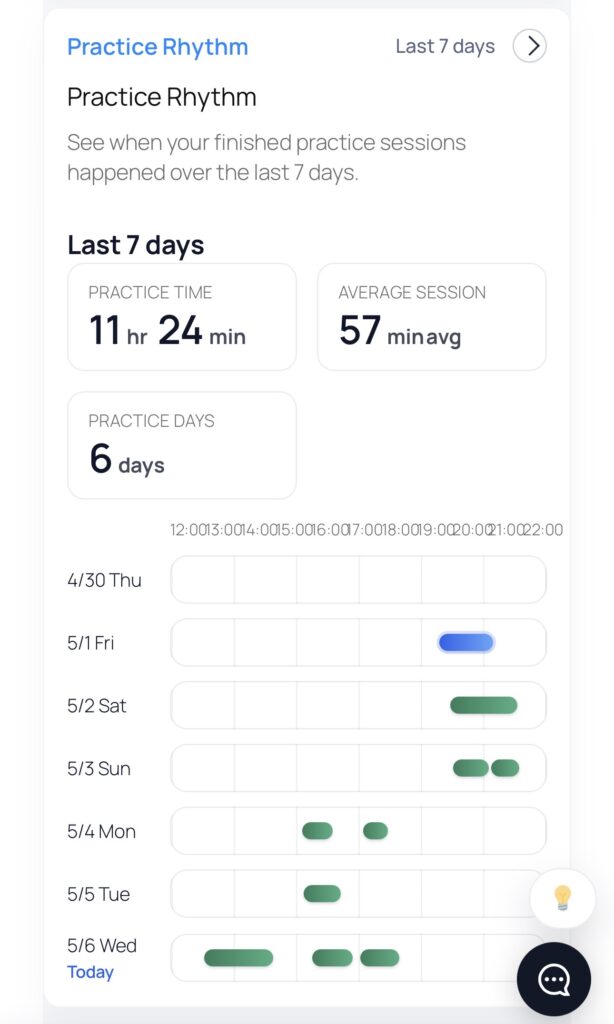
    You can now record the start and end times of your practice sessions. At Terakoya Cloud, we believe the true quality of practice lies in identifying specific challenges rather than just “putting in the hours.” However, tracking your time is a great way to understand your personal rhythm and is a highly requested feature for those who value time management. We decided to implement this to support every style of learning.

    Screenshot

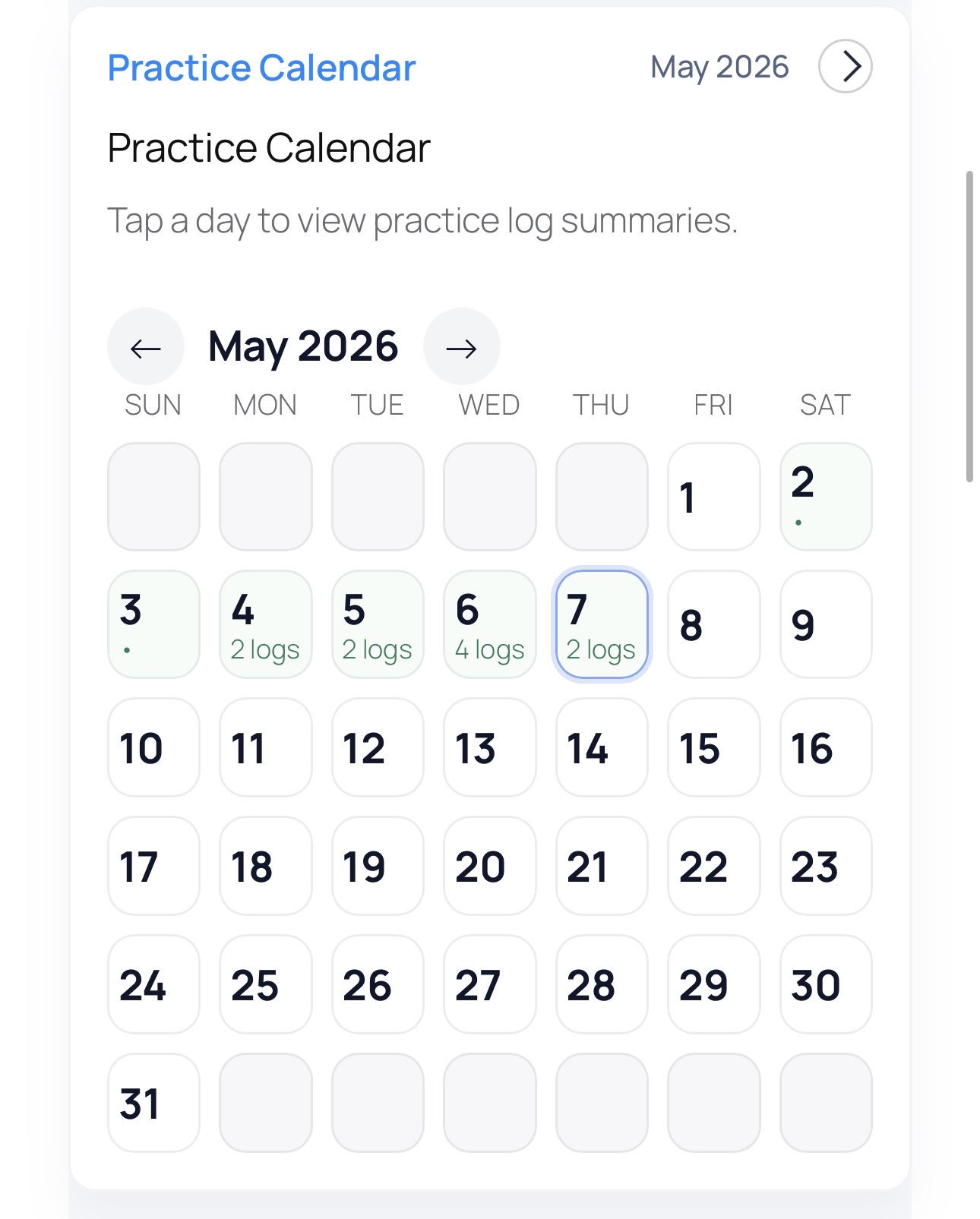
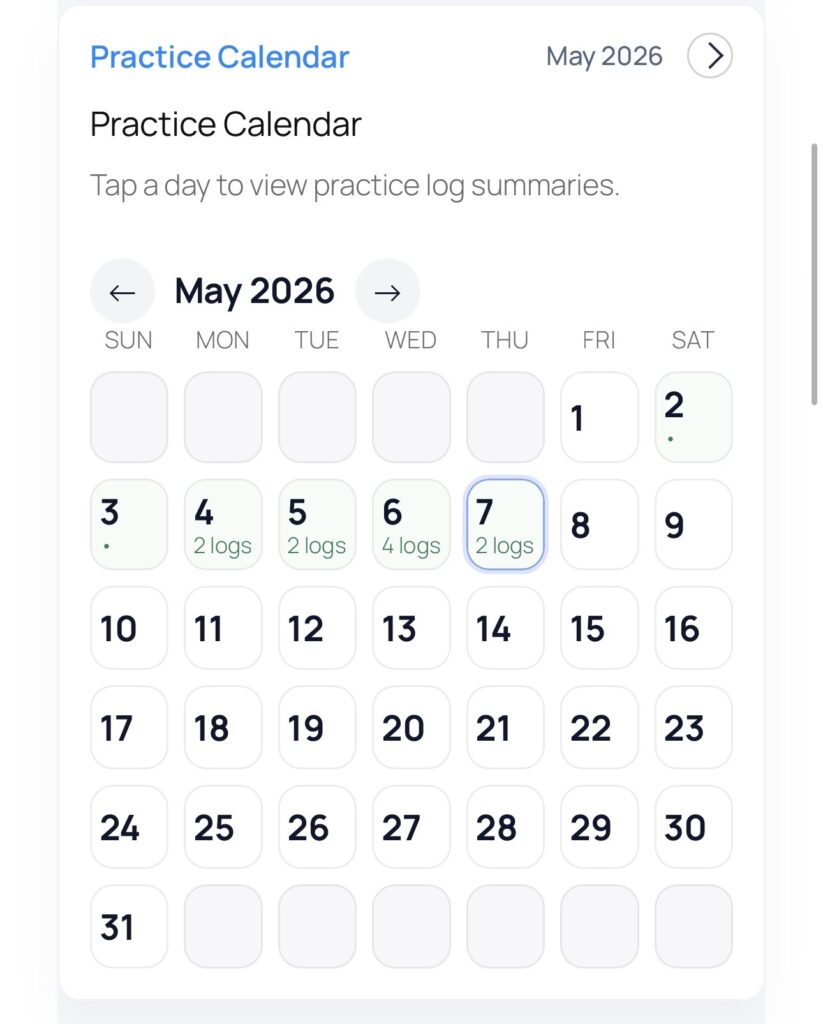
    With this update, you can now visually track your practice flow. By checking your total practice time and daily average over the past 7 days, you can better manage your scheduling and maintain a steady pace.


    While keeping records is important, the ultimate goal is to increase the effectiveness of your practice. We know that practicing an instrument can often feel like a lonely battle, which is why Terakoya Cloud focuses on connecting with others.

    In our next update, we will introduce a new feature designed to make your practice even more intensive—and more enjoyable!

    Stay tuned!

  • [Update] Intuitive & Effortless. New Rating System and Dashboard Live Now!

    [Update] Intuitive & Effortless. New Rating System and Dashboard Live Now!

    We’ve updated the Terakoya Cloud (TCPL) user interface! This update focuses on making your daily practice sessions easier to log and more visual to review.

    1. Simpler “Focus” Ratings

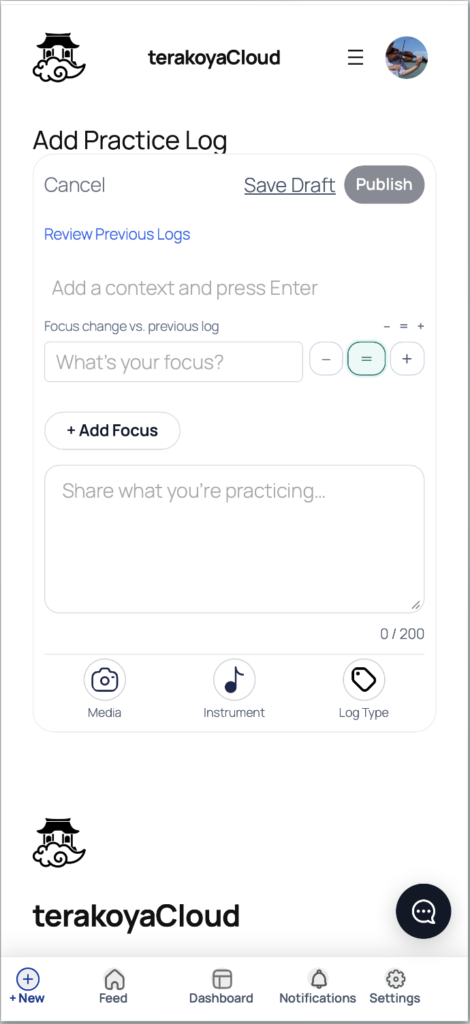
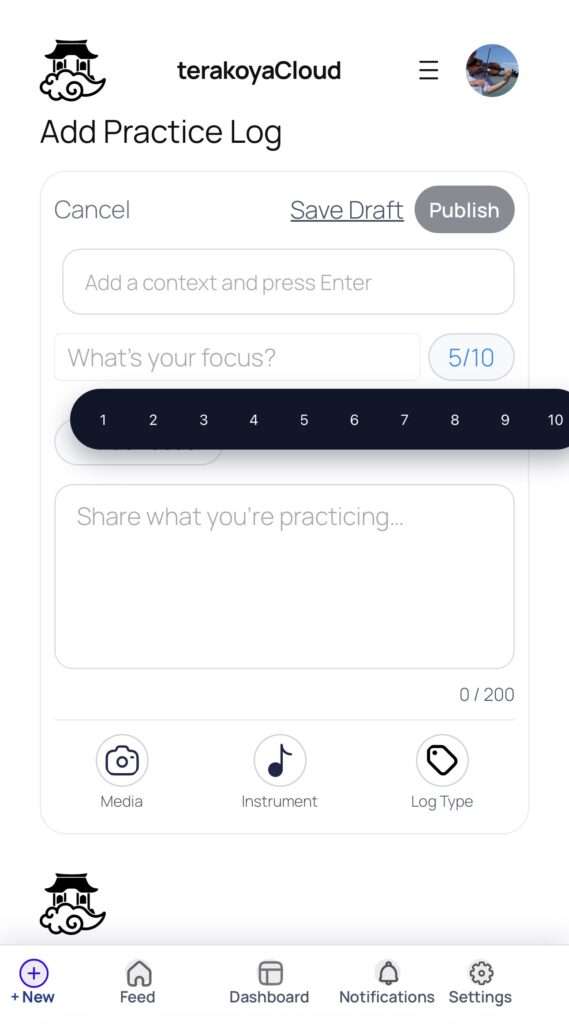
    When logging your practice, you track your “Focus”—those long-term technical goals like posture, fingering, or bowing.

    Previously, we used a 1-to-10 scale. However, based on your feedback that “numbers are hard to decide” and “I want something more casual,” we’ve simplified it to a 3-point system based on your previous session:

    • Plus (+): Improved
    • Neutral (=): No change
    • Minus (-): Needs work

    By simply comparing yourself to “who you were yesterday,” logging becomes frictionless and much easier to maintain as a habit.

    2. Visualize Your Journey: The Dashboard

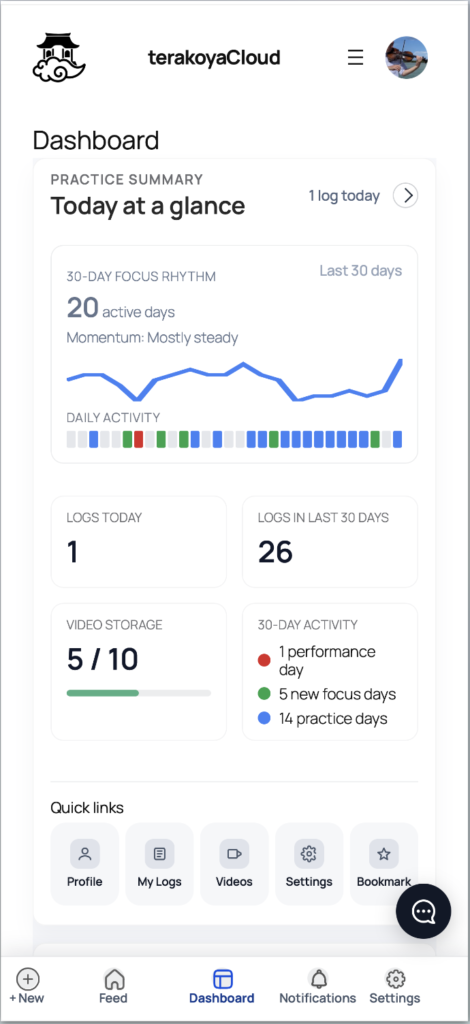
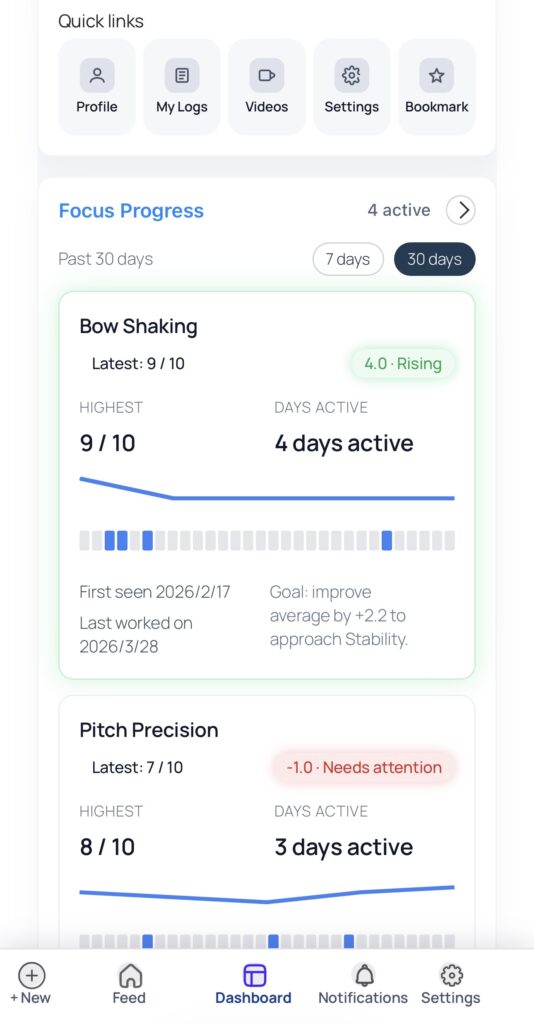
    We’ve built a dedicated Dashboard to help you see your progress at a glance.

    • Today at a Glance: Get a quick overview of your overall status.
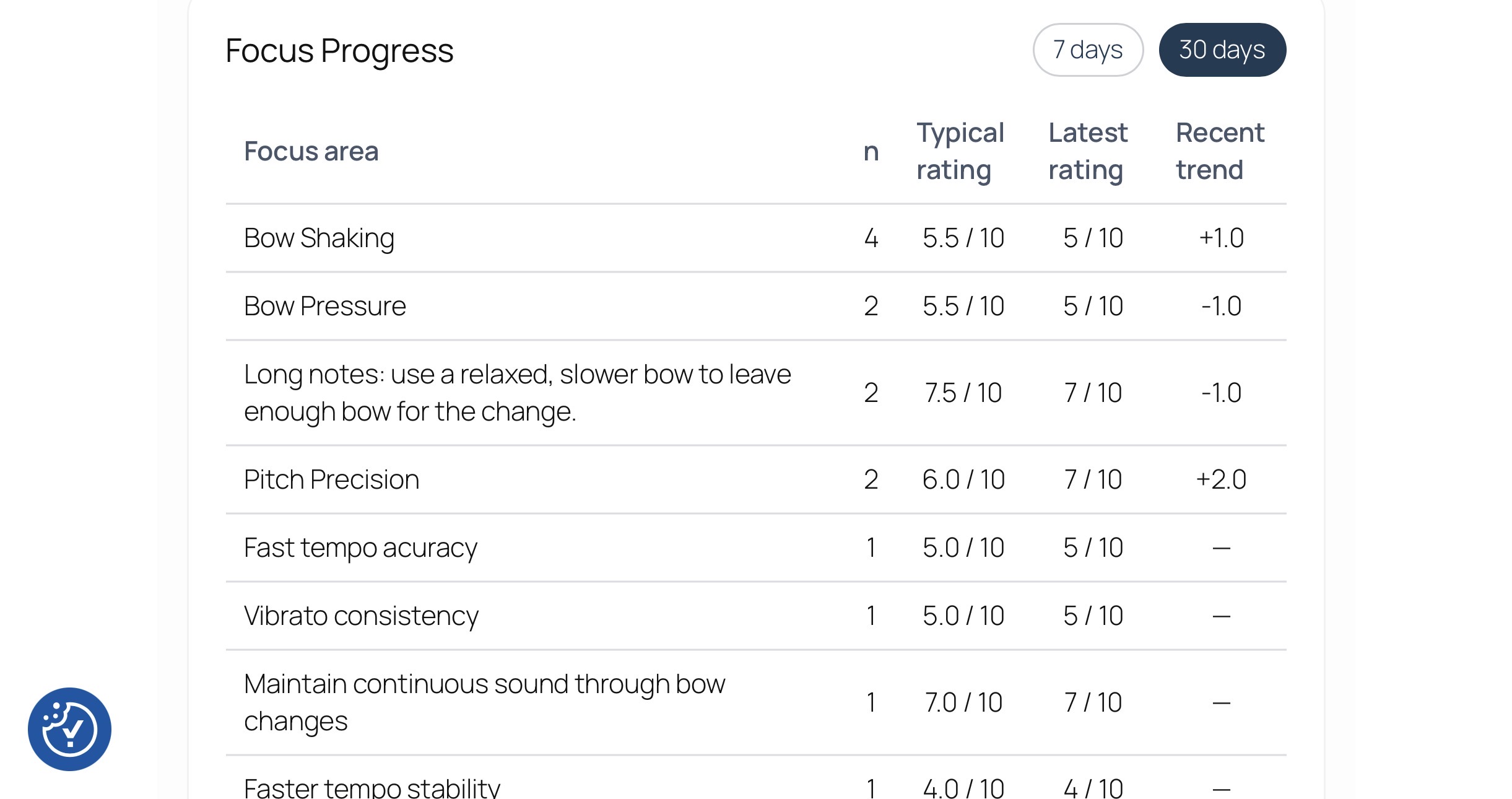
    • Focus Progress: Track how specific technical challenges are improving over time.

    Since this is based on self-evaluation, you might sometimes wonder if you’re being too easy or too hard on yourself. But by keeping at it, you’ll naturally gain a clearer perspective on your growth, as if observing yourself from a distance.

    3. We Want to Hear from You (Feedback Feature)

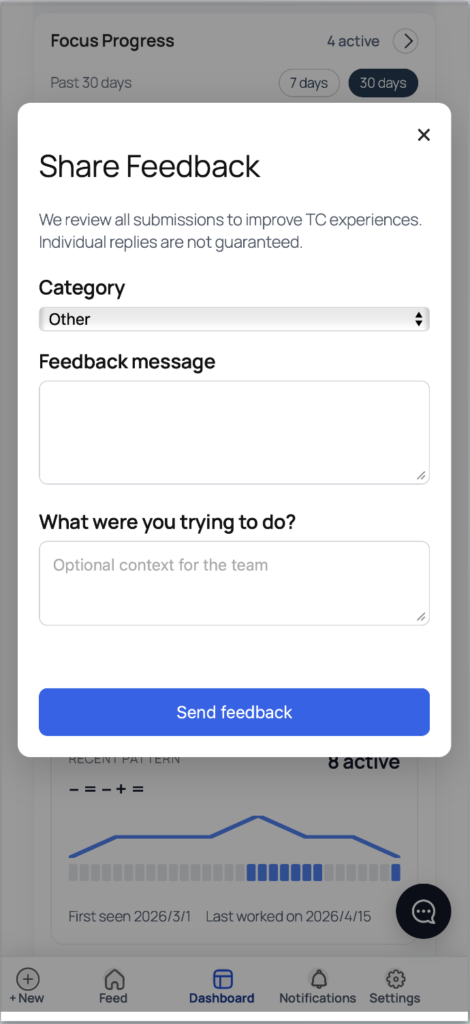
    TCPL is still evolving! We’ve added a new way for you to send us your thoughts directly from the site. Whether it’s a bug, a confusing UI, or a feature request, please let us know.

    Every piece of feedback helps us build a better platform for everyone.

    TCPL aims to be the ultimate partner for every music lover’s practice journey. If you haven’t tried it yet, please explore the new UI via our Demo User account. We’d love for you to sign up and see how it accelerates your progress!

  • When You Keep Recording “How Was Today Compared to Yesterday?”

    When You Keep Recording “How Was Today Compared to Yesterday?”

    Do you ever practice every day and still wonder, Am I really improving?

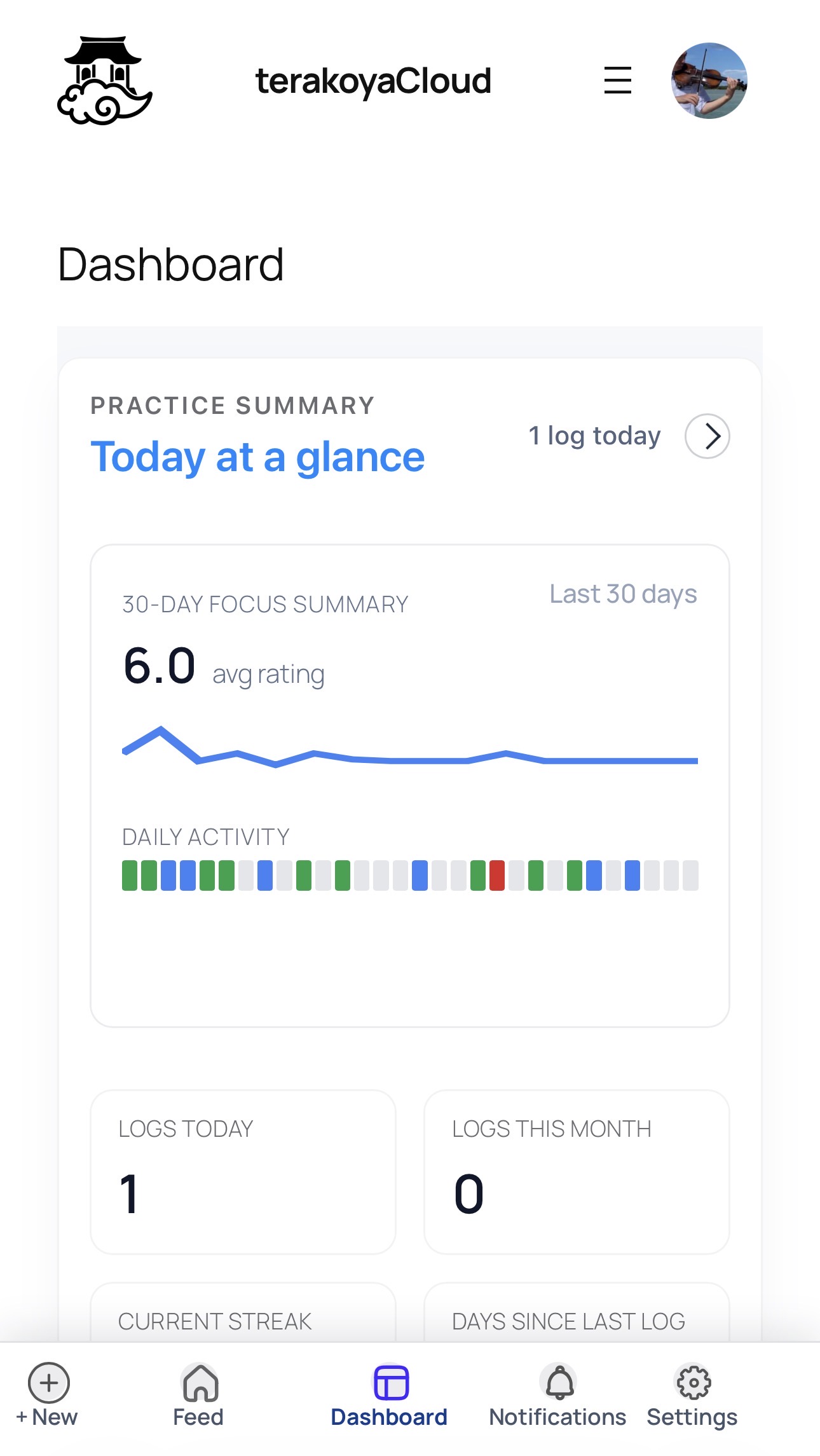
    The dashboard that brings your practice logs together has become even more powerful.

    After your daily instrument practice, all you have to do is give yourself a simple self-rating, like:
    “Was I able to play a little better today than yesterday?”
    By continuing to log that feeling, your records begin to turn into graphs.

    And for people who want to reflect a little more deeply, you can rate your playing from different angles on a scale of 1 to 10, such as:

    • My violin bowing felt good today!
    • But my intonation was not so great…
    • My rhythm felt good, and it was fun!

    When you keep recording your practice this way, you gradually start to see your strengths more clearly, notice the areas that need more work, and find hints for what you may want to focus on in future practice.

    In addition to your self-ratings, the dashboard also keeps track of your practice history over the past 7 or 30 days. This makes it easier to look back and see whether your practice sessions are becoming too spread out, and whether you are staying in regular touch with your instrument. There is no need to put too much pressure on yourself, but when you can clearly see the path of what you have done, practice starts to feel more rewarding.

    This time, I redesigned the dashboard in many visual ways, but I did not change anything complicated like how the data is collected or how the program works behind the scenes. I simply changed how the same data is presented. Even so, I was surprised by how much that alone changed what the dashboard communicates.

    Just by continuing to record “How was today compared to last time?”, it becomes easier to see the flow of your past practice and the things you may want to pay attention to from here on.

    Everything is free. Please try it first with a demo account!

  • Like Social Media, But Completely Different” — Introducing terakoyaCloud (TCPL): A Practice Log Platform

    Like Social Media, But Completely Different” — Introducing terakoyaCloud (TCPL): A Practice Log Platform

    By recording and accumulating your daily practice, you can reflect on the past and chart your path forward. While terakoyaCloud.com (TCPL) may look like a social network where you share what you’re working on, its essence is worlds apart from traditional SNS.

    TCPL isn’t a stage for flaunting “perfect” performances. Instead, it’s a focused space for practitioners to quietly grow together. The name “Terakoya” refers to traditional Japanese private schools where everyone was both a student and a teacher. Here are four key ways TCPL redefines the practice experience.


    1. Total Control Over Your Privacy

    Practice isn’t always meant for an audience. On TCPL, you can choose exactly who sees your progress based on your daily mood or the nature of your work:

    • Public: Share your journey with the entire world.
    • TCPL Members Only: Keep it within our community of dedicated learners.
    • Invitees Only: Share exclusively with specific mentors or friends.
    • Private: Use it as a personal journal for your own reflection.

    Context & Focus: On the public feed, we only highlight your “Context” and “Focus.” This semi-anonymous approach allows others to learn from your process while you gain inspiration from theirs. This “mutual support” is the core strength of TCPL.

    2. Freedom from “Likes” and “Follower Counts”

    The most defining feature of TCPL is the absence of vanity metrics.

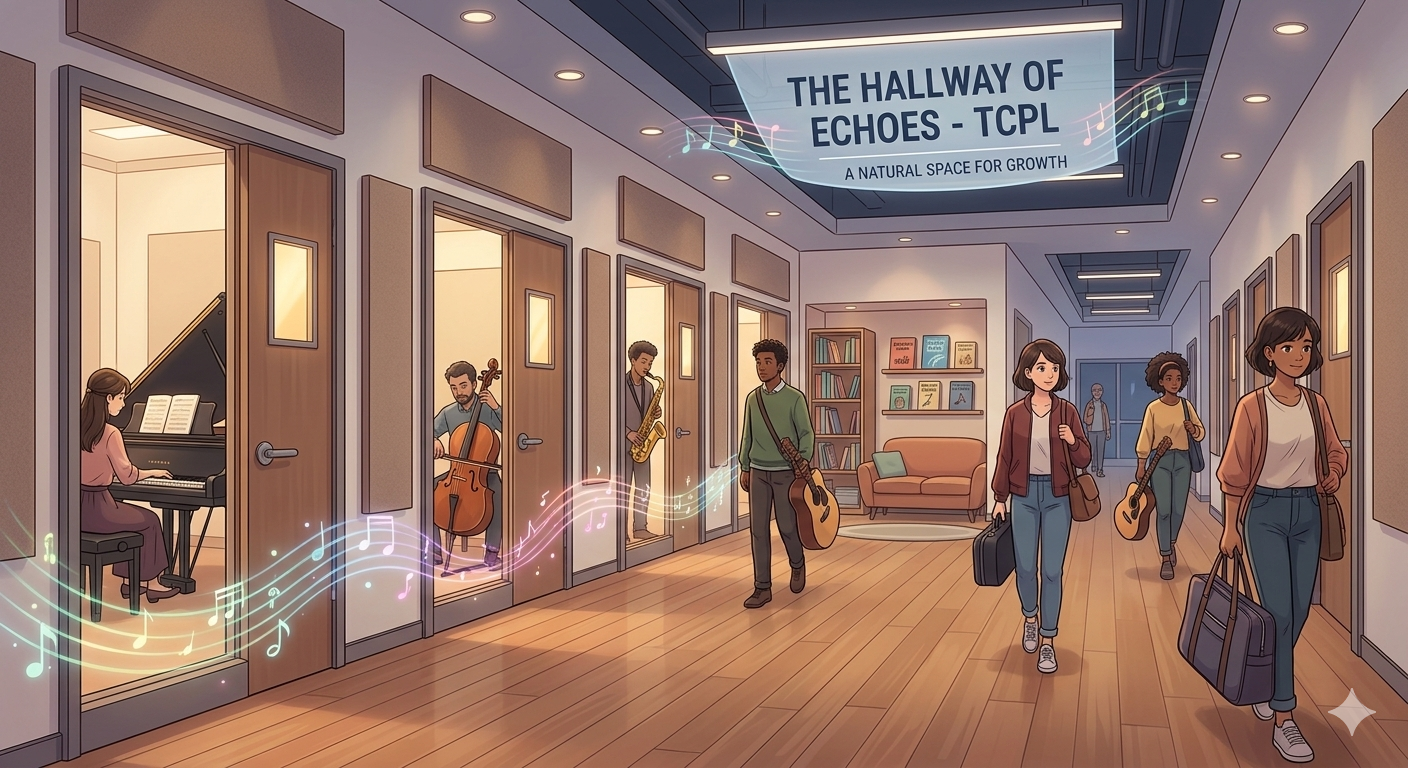
    Think of walking down the hallway of a music conservatory. You hear someone practicing behind a closed door. There are no “likes” or “follower counts” visible—just the pure, honest sound of music being shaped. TCPL recreates that organic, pressure-free environment.

    • Personal Bookmarks: You can keep track of users who inspire you, but your bookmark list is for your eyes only. No one else knows who you are following.

    3. Seeking Advice Through “Invites”

    When you hit a wall and need feedback, TCPL empowers you to take action through “Direct” or “Open” Invites.

    • Hand-picked Advice: Instead of chasing influencers, you can request advice from anyone whose practice logs resonate with you.
    • Closed Dialogue: When an invitee responds, the conversation is private between you and them. Even if you receive multiple responses, contributors cannot see each other’s comments.

    This design ensures a safe space for honest vulnerability and deep, meaningful exchange.

    4. Designed for Respect, Not Virality

    While you can share your own logs to external platforms like X, Facebook, or Threads, TCPL does not have a “repost” or “retweet” function for other people’s content.

    We believe in respecting the creator’s intent. If you restrict your privacy settings, your content stays within your chosen circle. We’ve prioritized the user’s right to control their own narrative over the platform’s desire for virality.


    Conclusion: A Place Where Your Growth Comes First

    TCPL is built to prioritize your personal development while fostering a high-quality community. By documenting your daily practice, you’re not just helping yourself—you’re contributing to a cycle of learning that inspires others and eventually circles back to you.

    Ready to log your first step today? Join us at terakoyaCloud.

  • Try It Free — No Signup Required: TCPL Demo Users Now Available

    Try It Free — No Signup Required: TCPL Demo Users Now Available

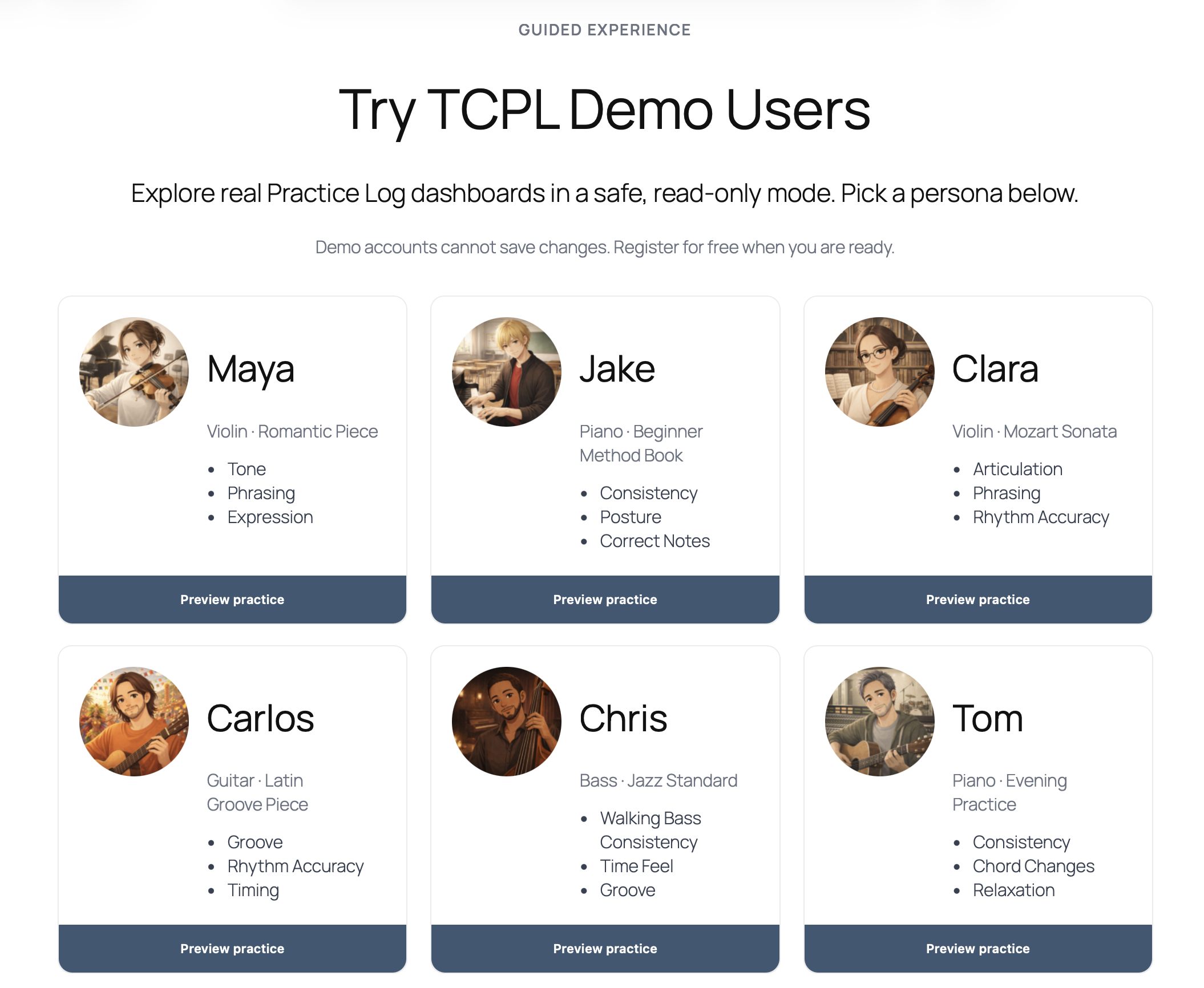
    We have released demo users on terakoyaCloud so you can experience how TCPL works.

    You can explore real Practice Log dashboards without creating an account.
    Everything runs in a safe read-only mode, so you can freely browse the system.

    If you’re wondering:

    • What can this platform actually do?
    • How do people log their practice?
    • What does the dashboard look like?

    The best way to understand it is simply to try it yourself.


    What You Can Explore

    The demo users allow you to see how musicians actually use TCPL to structure their practice.

    You can explore things like:

    • How Practice Logs are recorded
    • How Focus is used to track ongoing improvement
    • How Context represents goals such as pieces or performances
    • How the dashboard organizes practice history
    • How feedback and collaboration can work

    Each demo persona represents a different type of musician and practice style.

    For example:

    • Guitar Latin groove practice
    • Bach violin practice
    • Daily piano sessions
    • Cello Bach suites
    • Beginner piano practice

    This gives you a realistic picture of how the platform can be used.


    Try the Demo Users

    You can explore the demo accounts here:

    When you click a persona, you’ll enter the system as that user and can browse their dashboard and practice logs.

    To keep things safe and simple, demo accounts run in read-only mode.

    That means:

    • No changes can be saved
    • No posts can be published
    • Nothing will affect the real system

    You can simply explore how everything works.


    Why We Built Demo Users

    Practicing an instrument is often a very solitary process.

    Many musicians struggle with questions like:

    • Am I practicing the right things?
    • Am I actually improving?
    • How do other people structure their practice?

    Without visibility into how others practice, it’s easy to feel lost.

    terakoyaCloud was created with a simple idea:

    Practice can be shared.

    You can learn from someone else’s practice,
    and your own practice might inspire someone else.

    The goal is to create a space where musicians can

    • document their practice
    • reflect on progress
    • and support each other’s growth.

    Start Your Own Practice Log

    Once you’ve explored the demo users, you can create your own account and start logging your practice.

    TCPL allows you to:

    • Record practice sessions
    • Organize goals and challenges
    • Invite feedback from others

    All of this is free to use.


    Start by exploring the demo users and see how musicians structure their practice.

    Your practice might one day inspire someone else.

    What is TCPL?

    TCPL (TerakoyaCloud Practice Log) is a platform designed to help musicians make their practice more visible, structured, and collaborative.

    Instead of practicing alone without feedback, TCPL allows musicians to:

    • record their practice sessions
    • track long-term improvement through Focus
    • organize goals such as pieces or performances through Context
    • invite feedback from other musicians

    The idea is simple:

    Your practice can help someone else.

    By sharing practice logs, musicians can learn from each other’s process—not just the final performance.

    Whether you’re a beginner or an experienced player, TCPL helps turn daily practice into a shared learning experience.

  • You Don’t Have to Practice Alone

    You Don’t Have to Practice Alone

    One of the hardest parts of practicing an instrument is the loneliness.

    For instruments like the piano, both practicing and performing are often solitary activities.
    But even with other instruments, practicing alone is something every musician must face.

    How well am I actually doing?
    Am I really improving?

    Almost every musician has experienced the uncertainty of judging their own progress.
    Sometimes the results are unclear, and the motivation fades.

    If you have friends nearby who also play music, that can be a great source of support.
    But not everyone has that kind of environment.

    terakoyaCloud was created to ease this sense of isolation.

    As explained earlier, the Practice Log allows you to record your practice sessions.
    This helps you review what you’ve done and clarify your next goals.

    But that’s not all.

    Your logs appear in the Feed, where they are displayed alongside the practice logs of others.

    By seeing how others practice, you may discover new ideas.
    At the same time, your own approach might help someone else.

    However, there is an important principle here:

    Privacy.

    On terakoyaCloud, the focus is not on who posted something.

    Instead, the emphasis is on the practice itself.

    You can also choose the visibility of each log:

    • Private — visible only to yourself
    • Member Only — visible to terakoyaCloud members
    • Public — visible to anyone on the internet

    And you can decide this for every single post.

    When you’re trying something new and feel unsure, you might start with a private log.
    Later, once you feel more confident, you can choose to share it.

    There is another clear difference from typical social media platforms.

    There are no “likes.”
    There is no follow system.

    This space is not designed for chasing approval.
    It is designed so you can record your practice at your own pace, without pressure.


    When You Want Feedback

    Of course, there are times when you want advice.

    You might think:

    “Am I doing this right?”
    “Maybe someone else could give me a hint.”

    For those moments, terakoyaCloud offers the Invite feature.

    There are two ways to request feedback.

    Open Invite

    You can invite anyone to give feedback on your log.

    Direct Invite

    You can send an invitation directly to someone you trust or respect.

    Responding to an invitation is always optional.
    No one is obligated to reply.

    There are no hierarchies or expectations here.

    You decide when to share.
    You decide when to ask for help.

    This freedom is part of the culture of terakoyaCloud.


    When You Don’t Know What to Practice

    Sometimes you simply don’t know what your focus should be.

    That’s okay.

    You can leave the Focus field empty and simply post a photo or video of your practice.

    Then you can share it through an Open Invite, and others may offer suggestions.

    Someone might say:

    “Maybe you could try focusing on this.”

    Your goals don’t have to be clear from the beginning.
    Sometimes they emerge along the way.


    A Modern Terakoya

    Practicing an instrument can feel like a long and lonely journey.

    But imagine looking around and realizing
    there are others walking the same path.

    People who quietly support each other.

    That is the kind of place terakoyaCloud hopes to become.

    Record your practice.
    And if you can, help someone else along the way.

    Your experience level doesn’t matter.

    Anyone can become someone else’s support.

  • Goal Setting for Deeper Practice: Focus and Context

    Goal Setting for Deeper Practice: Focus and Context

    When you practice an instrument like piano or violin, what exactly are you trying to improve?

    At terakoyaCloud, we divide practice goals into two different categories:

    Focus and Context.

    Both are goals in a broad sense, but they play very different roles in how we think about practice.


    Context: Goals with a natural endpoint

    A Context is a goal that has a clear boundary.

    For example:

    • Preparing for a concert, recital, or competition
    • Practicing a specific piece
    • Working toward an upcoming performance

    If you are practicing Beethoven’s Für Elise, that is a Context.

    If you are preparing for a recital next month, that is also a Context.

    Contexts eventually reach an endpoint.
    The piece is performed. The event happens. The preparation phase ends.

    Because of that natural boundary, we call these Contexts.


    Focus: Continuous improvement

    A Focus is different.

    A Focus is something you are continuously trying to improve in your playing, regardless of the piece or event.

    For example:

    • reacting clearly to dynamics such as forte, piano, or crescendo
    • keeping sixteenth notes even
    • maintaining a balanced posture
    • avoiding the habit of rushing the tempo

    These issues appear across many pieces.

    You might notice the same problem while playing Für Elise, Mozart’s Turkish March, or any other piece you work on.

    A Focus is not tied to a specific work.
    It is a broader challenge that affects your overall musicianship.

    Improving a Focus improves your playing everywhere.


    Why separate them?

    At first, this way of thinking might seem a little detailed.

    But organizing practice this way helps increase the resolution of how we listen to and think about music.

    Instead of practicing only pieces, you begin to notice the underlying elements of your playing.

    This deeper awareness allows you to explore music more fully—and enjoy it for a much longer time.

    And interestingly, the habit of increasing this kind of “resolution” often extends beyond music.
    It becomes a way of understanding many other things more clearly as well.


    Learning from each other

    Later articles will explore this more deeply, but there is another important reason we emphasize Focus.

    When many musicians share their Focus inside terakoyaCloud, something interesting begins to happen.

    Musicians start learning from each other.

    Someone else’s practice approach might inspire your own.
    And your own discoveries might become the spark for someone else.

    Practice stops being an isolated activity.

    It becomes a shared process of exploration.


    What if you don’t know your Focus yet?

    For many beginners, this way of thinking about practice may feel unfamiliar.

    That’s completely okay.

    If you’re not sure what your Focus should be, simply record a short video of your practice (without showing your face or location if you prefer), upload it, and select “Not Sure” as your Focus.

    That’s essentially a way of asking the community for help.


    Remember: this is a terakoya

    In historical Japan, a terakoya was a place where people gathered to learn together.

    terakoyaCloud follows that same spirit.

    It’s not just a notebook where you record your own practice.

    It’s not a place where the teacher’s opinion is the only reference point.

    It’s a place where musicians share their challenges, learn from one another, and discover solutions together.

    Start by simply recording your practice.

    Over time, the important details in your playing will begin to reveal themselves.

  • Do You Feel Progress in Your Instrument Practice?

    Do You Feel Progress in Your Instrument Practice?

    Visualizing Your Practice: The terakoyaCloud Dashboard

    Do you feel that your instrument practice is steadily progressing?

    Music is enjoyable and can bring an extraordinary sense of joy.
    When you play an instrument, the emotion you feel in the sound you create may be something only those who truly love music can understand.

    Yet many musicians would probably agree on one thing.
    Playing an instrument is not always fun all the time.

    There are moments when progress feels slow, when you feel stuck, or when you stumble.
    Because of that, it’s not uncommon to see instruments that were once purchased with excitement now sitting quietly in the corner of a room.

    terakoyaCloud was created with a simple idea: to build an environment where people who start playing an instrument can continue enjoying music for as long as possible.


    Why It’s Hard to Feel Progress Even When You Practice

    You practice, yet you don’t feel like you’re improving.
    Have you ever experienced that feeling?

    You practiced yesterday.
    You practiced today.
    But whether that practice is truly moving forward is surprisingly difficult to recognize.

    For example:

    • What exactly you practiced last week
    • What challenges you were struggling with a month ago
    • What specific goals you were working toward

    Most people cannot clearly remember these things.

    Even though practice is accumulating, it can become invisible to us.
    And when that happens, we start to wonder if we’re actually improving at all.


    What Changes When Practice Becomes Visible

    What if your daily practice remained as a visible record?

    What you practiced yesterday.
    What you focused on.
    And what kind of results or feelings you had from that practice.

    When these small steps become visible, the overall flow of your practice starts to become clearer.

    Improvement in music rarely happens suddenly.
    Most of the time, it comes from many small trials and adjustments.

    By keeping a record of those small steps, practice changes from something you simply “keep doing” into a process you can actually see.


    The terakoyaCloud Dashboard

    terakoyaCloud provides a Dashboard where you can review all of your practice records in one place.

    On this page, you can see your practice in several different ways.

    For example:

    • How consistently you have been practicing
    • How many practice logs you have posted this month
    • What focuses or goals you are currently working on

    Each day of practice may seem small, but when those days accumulate, you begin to see your own personal progress.

    The Dashboard is the place where you can see that flow.


    How Are These Records Created?

    So how are the records displayed on the Dashboard actually created?

    In terakoyaCloud, daily practice is recorded as a Practice Log.
    As these logs accumulate, the Dashboard begins to show the progression of your practice.

    In the next article, we will introduce the Practice Log feature.
    How are these practice records created, and how do they build over time?

  • The Philosophy Behind the “Add a Practice Log” Form — TCPL as a Runway to the World

    The “Add a Practice Log” form in TCPL is not just a submission form.

    It is a runway before taking off into the world.

    This article records the meaning behind each section and why it was designed this way — so we never forget the core philosophy.


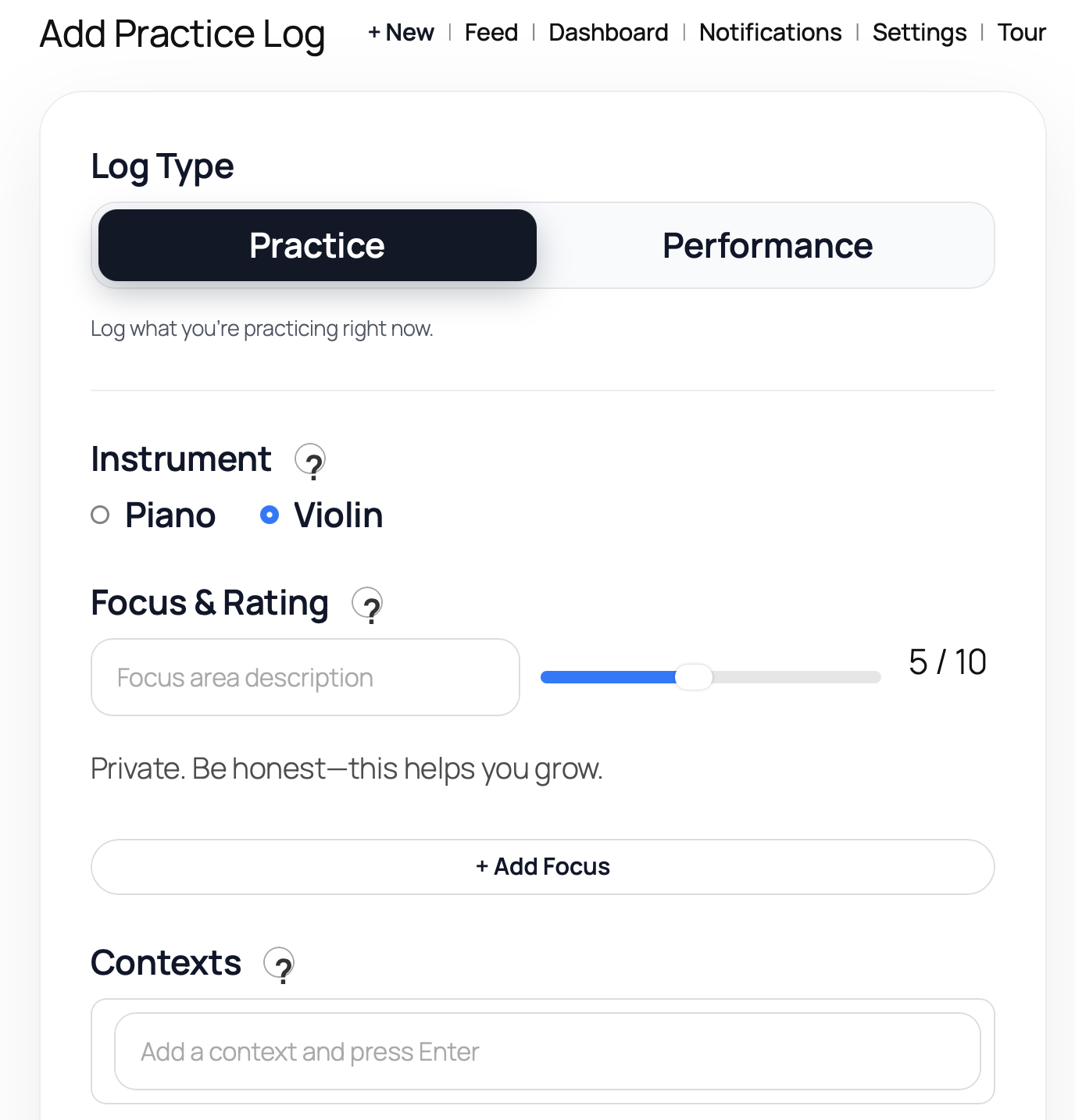
    1. Log Type (Set Focus / Working on / Performance)

    There are three phases of a practice log:

    • Set Focus: Declaring what you are about to work on.
    • Working on: A log of ongoing practice.
    • Performance: A more polished or completed version.

    TCPL is not a place only for finished performances. It is a place that values the process.


    2. Instrument

    Select your instrument. This is more than categorization — it connects to future value.

    • Feed filtering
    • Future analytics (trends, Focus, practice patterns)
    • Connecting musicians playing the same instrument

    3. Focus & Rating

    This section visualizes growth. Social media shows results. TCPL preserves the journey.

    The progress bar is not for others — it is for you to see your own growth.


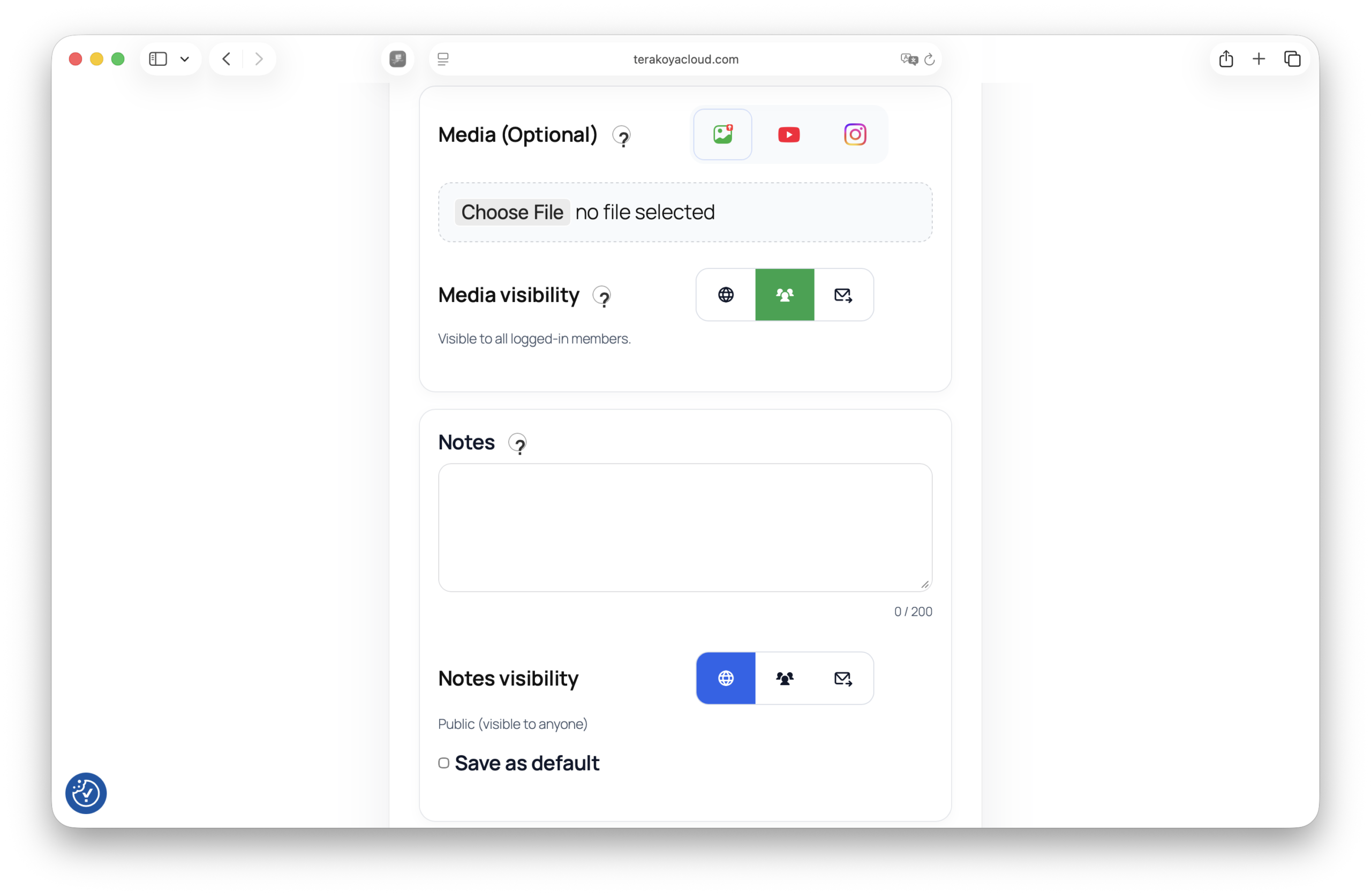
    4. Media (Optional)

    This is the heart of TCPL.

    TCPL is a place to speak through music, not through words.

    • Upload
    • YouTube
    • Instagram

    In the future, TCPL itself may become a stage for performance.


    5. Media Visibility (Core Design)

    This is the most important and most easily misunderstood part of the system.

    ① Members (Default)

    Visible only to logged-in TC members. This is the runway phase.

    • Not immediately exposed to the world
    • Shared with members who share the same philosophy
    • Relatively safer regarding copyright concerns

    ② Public (noindex mode)

    Visible to anyone with the link. However, currently configured as noindex (search engines blocked).

    • Reduces copyright exposure
    • Limits uncontrolled distribution
    • Allows controlled experimentation

    Public means: ready to take off.

    ③ Invited (Focused Feedback)

    Visible only to approved invitees (accepted or selected). Designed for serious, focused feedback.


    Important: Visibility and Invitations Are Separate

    • Visibility = Who can view the content
    • Invitation = Who can submit feedback

    Even if a log is Public, feedback can only be submitted through Invitations. These two systems must remain independent.


    6. Notes

    Notes provide context behind the music — intention, challenges, and reflections.

    Music is the main voice. Notes are supporting context.

    Notes Visibility

    • Private (Default): Only you can read your notes.
    • Invite-only: Only approved invitees can read them.

    Even if Media is Public, Notes can remain Invite-only. You may share your music with the world while keeping your inner thoughts limited to trusted viewers.


    Why Members Is the Default

    TCPL is designed as a training ground before stepping into platforms like X, Instagram, TikTok, or YouTube.

    Members = Runway

    Public = Takeoff

    Invited = Maintenance and fine-tuning


    What TCPL Ultimately Aims To Be

    Social media seeks reaction. TCPL seeks growth.

    TCPL is not meant to be a closed community. It is meant to prepare musicians to step into the world with confidence.

    For now, it is a runway. You run, refine, and then take off.

  • TerakoyaCloud Prototype Is Now Live

    ― A place to share your practice ―

    Today, I have published the prototype version of TerakoyaCloud (TCPL) on the live site.

    It is not a finished product.
    Rather, it is an experimental space that will grow over time.

    First, I will participate myself and start building my own Practice Logs.


    What TerakoyaCloud Aims To Be

    TerakoyaCloud is designed as a place where you can:

    • Record the process, not just the results
    • Describe what you are refining, not just the name of a piece
    • Request feedback only when you truly need it

    What Is TerakoyaCloud?

    TerakoyaCloud is a platform for people who practice.

    It is built around:

    🎹 Practice Log
    🎯 Goal (technical focus)
    🎻 Instrument organization
    ✉️ Invitation (feedback request)

    There are no “likes.”
    There are no follower counts.

    The aim is a quiet but forward-moving space.

    Here, we simply:

    Show up.
    Do the work.
    Visualize your practice.

    That’s all.


    It Is Still a Prototype

    This is currently an MVP (Minimum Viable Product).

    • The Invitation feature is still evolving
    • The UI is under refinement
    • Bugs may appear

    I chose to publish it anyway.

    Because the only way to improve it is to use it in real conditions.

    If you are curious, you are welcome to register and try it.
    Please understand that this is still a prototype.

    If necessary, registration may be temporarily limited.


    What Comes Next

    For now, I will focus on adding more logs.

    What kind of Goals will I set?
    How will I reflect on my practice?
    How will I use Invitations?

    Everything will be tested in practice.

    TerakoyaCloud aims to become a place where
    everyone is both a learner and a teacher.

    It is not complete.

    But it has begun.

    This is where it starts.

    — Katsufumi Seki