
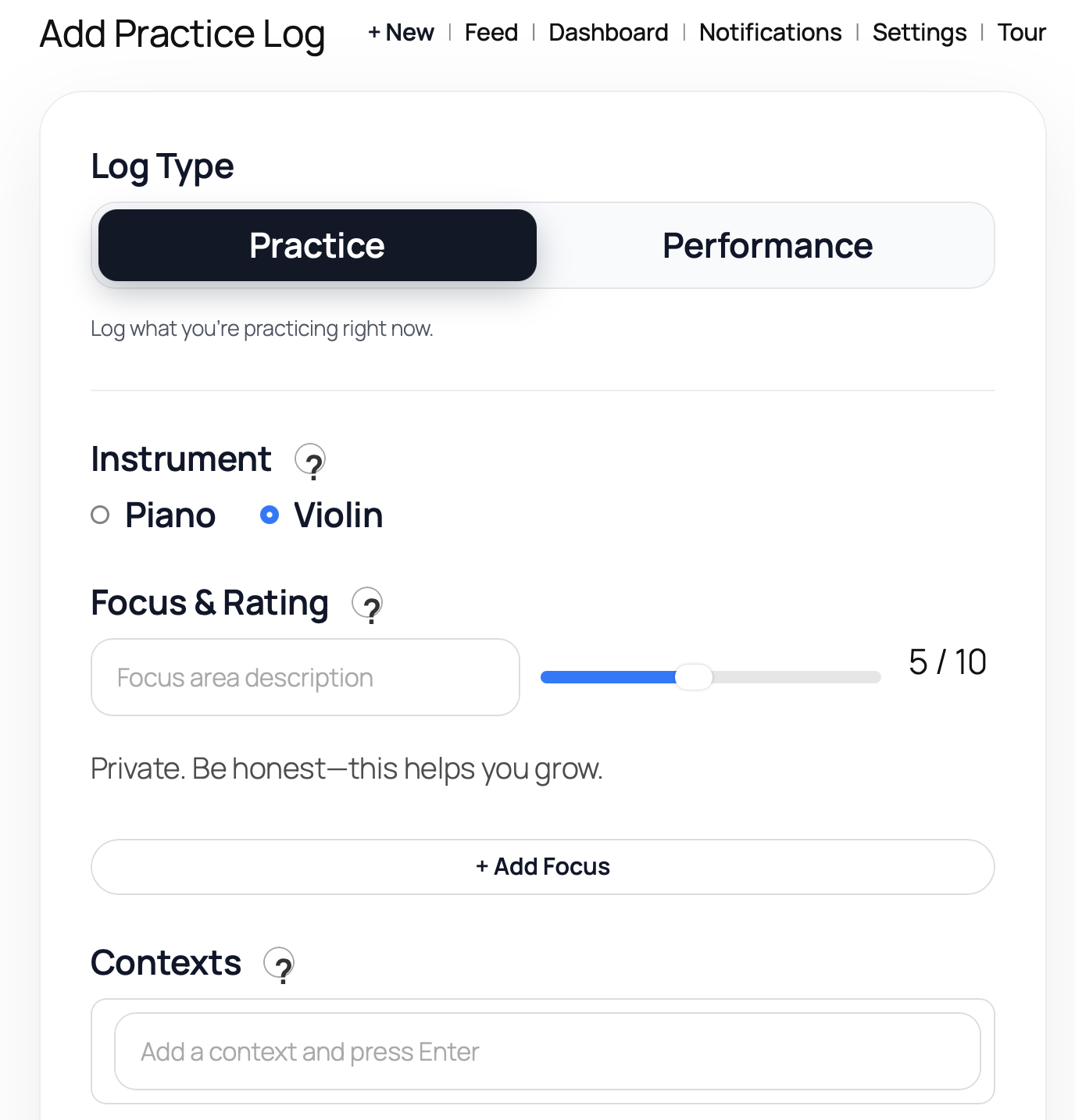
When you practice an instrument like piano or violin, what exactly are you trying to improve?
At terakoyaCloud, we divide practice goals into two different categories:
Focus and Context.
Both are goals in a broad sense, but they play very different roles in how we think about practice.
Context: Goals with a natural endpoint
A Context is a goal that has a clear boundary.
For example:
- Preparing for a concert, recital, or competition
- Practicing a specific piece
- Working toward an upcoming performance
If you are practicing Beethoven’s Für Elise, that is a Context.
If you are preparing for a recital next month, that is also a Context.
Contexts eventually reach an endpoint.
The piece is performed. The event happens. The preparation phase ends.
Because of that natural boundary, we call these Contexts.
Focus: Continuous improvement
A Focus is different.
A Focus is something you are continuously trying to improve in your playing, regardless of the piece or event.
For example:
- reacting clearly to dynamics such as forte, piano, or crescendo
- keeping sixteenth notes even
- maintaining a balanced posture
- avoiding the habit of rushing the tempo
These issues appear across many pieces.
You might notice the same problem while playing Für Elise, Mozart’s Turkish March, or any other piece you work on.
A Focus is not tied to a specific work.
It is a broader challenge that affects your overall musicianship.
Improving a Focus improves your playing everywhere.
Why separate them?
At first, this way of thinking might seem a little detailed.
But organizing practice this way helps increase the resolution of how we listen to and think about music.
Instead of practicing only pieces, you begin to notice the underlying elements of your playing.
This deeper awareness allows you to explore music more fully—and enjoy it for a much longer time.
And interestingly, the habit of increasing this kind of “resolution” often extends beyond music.
It becomes a way of understanding many other things more clearly as well.
Learning from each other
Later articles will explore this more deeply, but there is another important reason we emphasize Focus.
When many musicians share their Focus inside terakoyaCloud, something interesting begins to happen.
Musicians start learning from each other.
Someone else’s practice approach might inspire your own.
And your own discoveries might become the spark for someone else.
Practice stops being an isolated activity.
It becomes a shared process of exploration.
What if you don’t know your Focus yet?
For many beginners, this way of thinking about practice may feel unfamiliar.
That’s completely okay.
If you’re not sure what your Focus should be, simply record a short video of your practice (without showing your face or location if you prefer), upload it, and select “Not Sure” as your Focus.
That’s essentially a way of asking the community for help.
Remember: this is a terakoya
In historical Japan, a terakoya was a place where people gathered to learn together.
terakoyaCloud follows that same spirit.
It’s not just a notebook where you record your own practice.
It’s not a place where the teacher’s opinion is the only reference point.
It’s a place where musicians share their challenges, learn from one another, and discover solutions together.
Start by simply recording your practice.
Over time, the important details in your playing will begin to reveal themselves.